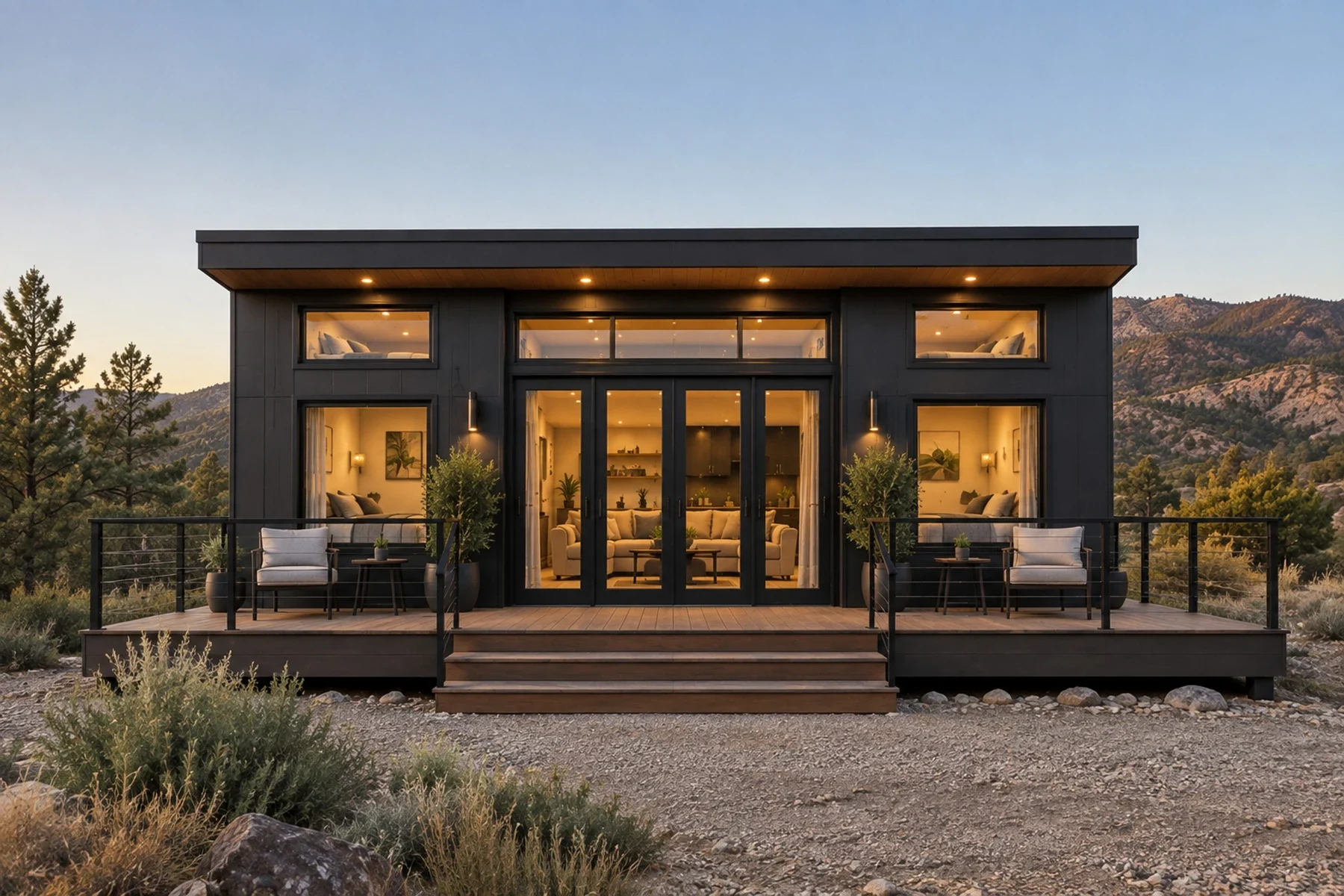
A park model is a defined product: a recreational vehicle built to a national standard, no larger than 400 square feet. "Tiny home" is a looser term that means one thing in everyday speech, another in the building code and, in Colorado, something specific in state law. The label matters because it decides where the cabin can go and how you can use it.
What a park model is
A park model RV is built on a single chassis, mounted on wheels, with no more than 400 square feet of area when it is set up. It is designed as temporary living quarters for recreation, camping or seasonal use, and its manufacturer certifies it to ANSI A119.5, the national standard for park model RVs. Ours carry the certification of the RV Industry Association (RVIA).
Because the standard is national, a certified park model can be delivered anywhere in the United States, and it can go wherever park models are allowed, such as RV resorts, campgrounds and glamping properties.
What a tiny home is
It depends on who is using the words.
- In everyday use, a tiny home is any small dwelling, on wheels or on a foundation, built to any standard or none.
- In the building code, the International Residential Code defines a tiny house as a dwelling of 400 square feet or less, not counting lofts. It is treated as a house: permitted and inspected locally.
- In Colorado law, a tiny home has been a regulated product since 2023: a structure of not more than 400 square feet, permanently built on a vehicle chassis, designed for long-term residency, and certified by the state Division of Housing.
So two cabins that look alike can be different things on paper, and the paper is what your planning office reads.
Which one is a Mytikas cabin?
Ridgeline™, Summit™ and our other cabins are park model RVs, RVIA certified to ANSI A119.5. We also build them to meet the most recent International Residential, Mechanical, Fuel Gas, Plumbing and Energy Conservation codes, and they are certified as Colorado tiny homes.
That combination is deliberate. A Mytikas cabin sits on a permanently integrated steel chassis, so it can be set as a permanent structure such as an ADU, as a temporary structure, or as an RVIA-certified park model with its axles and wheels, as your jurisdiction allows.
Film · 0:18
The steel chassis
The integrated steel chassis under every cabin.
What decides where it can go
Your land does, and the office that governs it.
- RV resorts, campgrounds and glamping properties: a certified park model can go wherever park models are allowed.
- Private land: your county or city planning office decides whether a cabin can be an ADU, a guest house or a full-time dwelling, and under which label.
Ask that office two questions before you order anything from anyone: which certifications do you accept for a dwelling on my parcel, and what foundation and utility connections do you require? We are glad to help with that conversation. Our six-step site guide walks through it.
Questions we hear
Is a park model an RV or a house? By its certification, an RV. Ours are also built to meet the most recent residential codes.
Can I live in one full time? Our cabins are built to residential codes. Whether one can serve as an ADU or a full-time dwelling on your land is decided by your local planning office.
Why are park models always under 400 square feet? The standard sets the limit. Our cabins are 399 square feet on the main level, with sleeping lofts above on Ridgeline and Summit.
Does a park model have to stay on wheels? No. Ours can keep its axles and wheels or be set on a permanent foundation, as your jurisdiction allows.
Sources: the park model definition used by RVIA and state motor vehicle administrators (AAMVA); the International Code Council on tiny houses; the Colorado Division of Housing on tiny homes.