When Disaster Strikes, Housing Can't Wait — The Case for High-Quality Tiny Homes
When a wildfire tears through a neighborhood or a hurricane levels a community, the immediate focus is survival. But within days, sometimes hours, a different crisis emerges: where do thousands of displaced people actually live while they rebuild?
It's a question the United States has been forced to answer repeatedly in recent years — and the answers haven't always been good enough.
Temporary shelters. FEMA trailers. Hotel rooms for weeks that stretch into months. These stopgap solutions come with real costs — financial, emotional, and practical. They put families far from their properties, making it harder to oversee cleanup and rebuilding. They're often poorly built, uncomfortable, and disconnected from the communities people are trying to return to.
The tiny home industry has been stepping up as a better answer. But not all tiny homes are created equal — and when people's lives are on the line, that difference matters enormously.
A Problem That Keeps Getting Bigger
2024 was a brutal year for natural disasters in the United States. Hurricanes Debby, Helene, and Milton carved through Florida and North Carolina, leaving catastrophic damage in their wake. FEMA approved more than $2.1 billion in aid — nearly $1 billion of that earmarked specifically for housing repairs and personal property replacement.
Then came the January 2025 Los Angeles fires, burning through more than 12,000 homes and forcing one of the largest displacement events in California history. In response, L.A. Mayor Karen Bass issued an emergency executive order and Governor Gavin Newsom moved to suspend key permitting requirements under state environmental law — all in the name of getting people housed faster.
The message was clear: the old way of handling disaster recovery housing isn't working. Speed, flexibility, and quality all need to improve. And tiny homes — particularly park model-style structures — are increasingly being recognized as a real part of the solution.
Why Tiny Homes Make Sense for Disaster Recovery
There are a few practical reasons tiny homes work well in disaster recovery scenarios.
Proximity. One of the biggest challenges for displaced homeowners is staying close to their property during the rebuild process. Managing contractors, monitoring progress, and making real-time decisions is dramatically easier when you're on-site or nearby. A well-placed tiny home on or near the affected property keeps families connected to the process rather than waiting it out in a hotel two towns over.
Speed. Prefabricated and factory-built tiny homes can be delivered and set up in a fraction of the time it takes to construct traditional housing. When communities need solutions in weeks, not years, that speed is invaluable.
Permanence potential. Unlike a FEMA trailer that gets hauled away when the crisis is declared over, a quality tiny home can transition into a permanent structure — a guest house, a rental unit, an ADU, or a standalone dwelling. That makes it a lasting home rather than a temporary band-aid.
Cost. Relative to traditional construction, high-quality tiny homes offer significant value, especially when you factor in the long-term utility they can provide after the immediate crisis has passed.
The Quality Problem Nobody Talks About Enough
Here's where the conversation gets more complicated.
The surge in demand for tiny homes during and after disasters has attracted every level of builder — from serious, precision manufacturers to operators cutting corners under the cover of urgency. NPR has documented the wide range in tiny home quality, noting that shelters in this category range from barely habitable to genuinely comfortable, residential-grade homes.
That gap is dangerous. A poorly built tiny home placed in a hurricane zone or at high altitude doesn't just fail to solve the problem — it creates new ones. Structures that can't handle heavy snow loads, extreme heat, or high wind events put families at risk and set communities back further.
This is why the "build fast" mentality, while understandable, has to be balanced with a commitment to building right. Disaster recovery is not the place to cut corners on materials, engineering, or craftsmanship.
What the Right Build Looks Like
The prefabricated home sector is projected to grow by more than $30 billion over the coming years — and the disaster recovery use case is a significant driver of that growth. But the industry's reputation will ultimately be shaped by the quality of what gets built, not just the volume.
A tiny home built for resilience should be able to answer yes to a few critical questions:
- Can it handle the climate it's being deployed into — whether that's 100+ lb snow loads at altitude, 110° desert heat, or hurricane-force winds?
- Is it built with materials that resist the conditions that caused the disaster in the first place — fire, moisture, rot, insects?
- Is it built to a standard that allows it to serve as a long-term dwelling, not just a temporary fix?
- Was it built by people who stand behind their work?
These aren't luxury considerations. For disaster recovery applications, they're baseline requirements.
Where Mytikas Fits In
At Mytikas Industries, disaster relief isn't an afterthought — it's one of the core reasons we build the way we build.
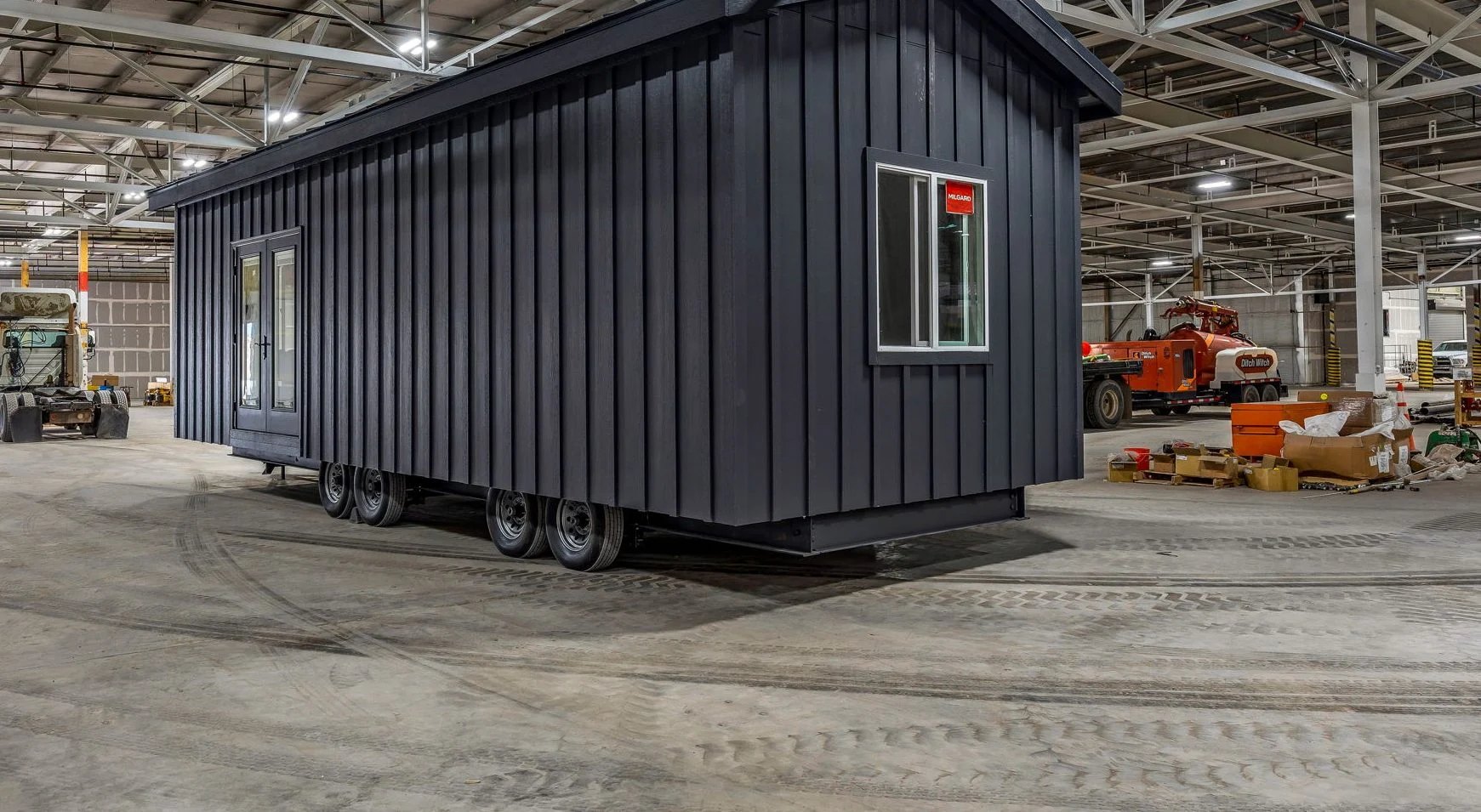
Our tiny homes are engineered with light-gauge steel structural systems and commercial-grade assemblies. Steel doesn't burn, rot, warp, or attract termites. It holds up under the conditions that send wood-framed structures to the scrap heap. Our homes are designed and tested for extreme environments — high snow loads, high heat, high wind — because we know that the communities most in need of resilient housing are often the ones facing the harshest conditions.
Every Mytikas home is built in our Florence, Colorado facility by full-time, in-house tradespeople — steel fabricators, framers, electricians, plumbers, HVAC specialists, and master woodworkers. These aren't outsourced crews or temporary contractors. They're dedicated employees who take direct responsibility for the quality of what leaves our facility.
We also believe that disaster recovery housing shouldn't look or feel like disaster housing. Our homes are designed with genuine comfort, high-end finishes, and both modern and traditional aesthetic options. Because people going through the hardest moments of their lives deserve a space that feels like home — not a reminder of what they lost.
The Bigger Picture
Natural disasters aren't slowing down. If anything, the frequency and intensity of climate-related events is accelerating the need for smarter, faster, more resilient housing solutions across the country.
The tiny home industry has a real opportunity to be part of that answer. But it has to show up with quality — with homes that are built to last, built to perform, and built by people who genuinely care about the outcome.
That's the standard we hold ourselves to at Mytikas. And it's the standard that disaster-affected communities deserve.
Interested in learning more about Mytikas tiny homes for disaster relief, resort development, workforce housing, or ADU applications? Reach out at mytikasindustries.com/tiny-homes or contact us directly at info@mytikasindustries.com.